

Behind the scenes at BOURBON Congo's Surfer Repair Center
Ensuring the availability and reliability of Crewboats requires rigorous organization, a wide range of technical expertise and a strong team spirit. In Pointe-Noire, Anthony Lautard, SRC Manager, takes us behind the scenes of his role, the Surfer Repair Center’s operations and the skills required every day to keep the vessels in service.
Can you tell us about yourself?
Anthony Lautard: I’m 43 and have a background in naval technical project management, profit center management and shipyard operations. I joined BOURBON in July 2024 as a Site Foreman before becoming SRC Manager in April 2025. I am now based in Pointe-Noire.
What types of vessels are serviced at the SRC in Congo?
AL: We maintain Crewboats ranging from 18 to 27 meters, with different types of activities, including annual technical overhauls, preventive maintenance and rapid interventions in the event of breakdowns or damage.
What does day-to-day work look like at the SRC?
AL: We can accommodate up to five Surfers simultaneously on the dry dock, as well as several vessels at our 50-meter pontoon. The SRC team consists of 34 employees, all Congolese, including mechanics, electricians, electronics technicians and welders. We also have a reconditioning workshop and a spare parts warehouse. Technical overhauls generally last between 22 and 30 days, while breakdown repairs can take anywhere from a few dozen minutes to several days, depending on the nature of the issue.
How is safety integrated into your daily operations?
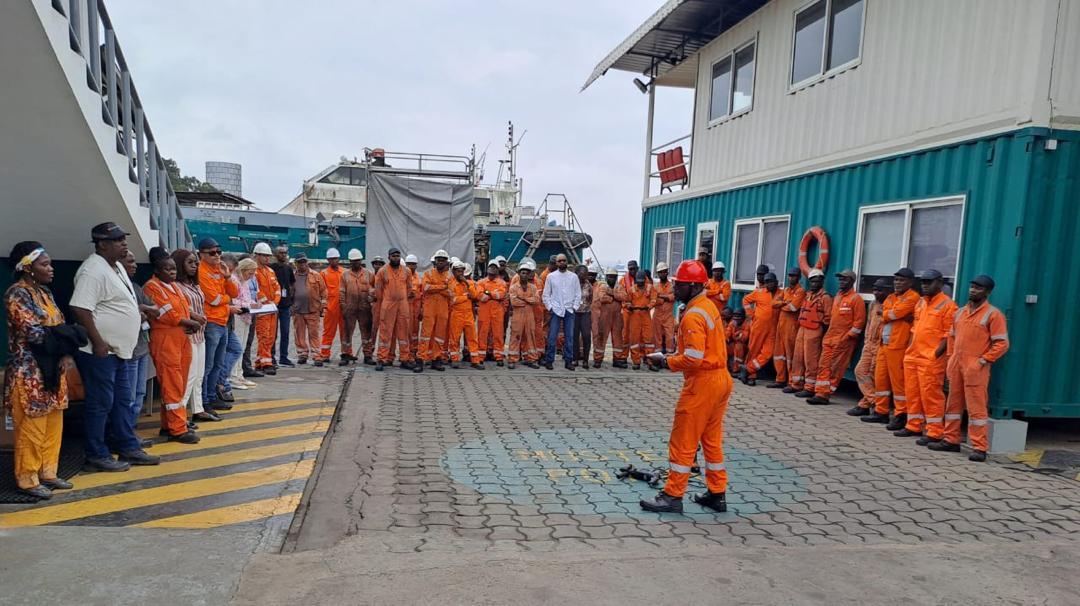
AL: Safety is a central priority. Every morning, we hold a Tool Box Talk, complemented by a weekly safety meeting and monthly drills covering fire, evacuation, first aid and other emergency situations. But above all, we involve our teams. Every Monday, employees have an opportunity to share their ideas and observations. Safety is not just about following instructions: it is built together with the people working on the ground. Today, we have reached two years without an accident or incident, which is a great source of pride for the entire team.
How do you develop your teams’ skills?
AL: Our teams already have extensive experience, with many employees having between 15 and 25 years of service. We therefore focus on targeted training to complement their expertise, including certification for certain roles, such as welders, through Bureau Veritas.
We are also working on handling and lifting training to establish a dedicated team for hoisting operations on board the Surfers. More broadly, skills development relies heavily on internal training and knowledge sharing.
What actions are being taken to reduce the environmental impact of the activity?
AL: We have implemented waste sorting across the site. Sensitive waste, such as used oil and batteries, is collected by specialized, certified companies. More broadly, hazardous waste, hydrocarbons and other potentially harmful materials are systematically removed and treated in accordance with applicable standards.
What has made the biggest impression on you since you joined?
AL: When I arrived, the SRC was undergoing a major restructuring. In one year, we managed to regain control of the site, reorganize the activities and re-energize the teams. Today, everyone is engaged and the results speak for themselves.
In 2025, the fleet’s technical availability rate reached 94%, with a peak of 99% in December, a level we had not achieved for several years. This achievement is above all a collective success. Our ambition is clear: to make BOURBON Congo’s SRC a center of excellence, able to share its practices and contribute to improving the performance of SRCs across the Group. We are clearly on the right track.

