
The master's expertise at the heart of a complex towing operation
Towing a jack-up over more than 500 nautical miles and then positioning it just two meters from a platform: operations like these require thorough preparation, experienced crews and seamless coordination. In February 2026, Nikolay Vasilev, Master Mariner and Senior Captain on board the Bourbon Liberty 216, took part in a particularly demanding operation between Benin and Côte d’Ivoire. He shares the story behind the mission and his profession.
Nikolay, can you tell us about this operation?
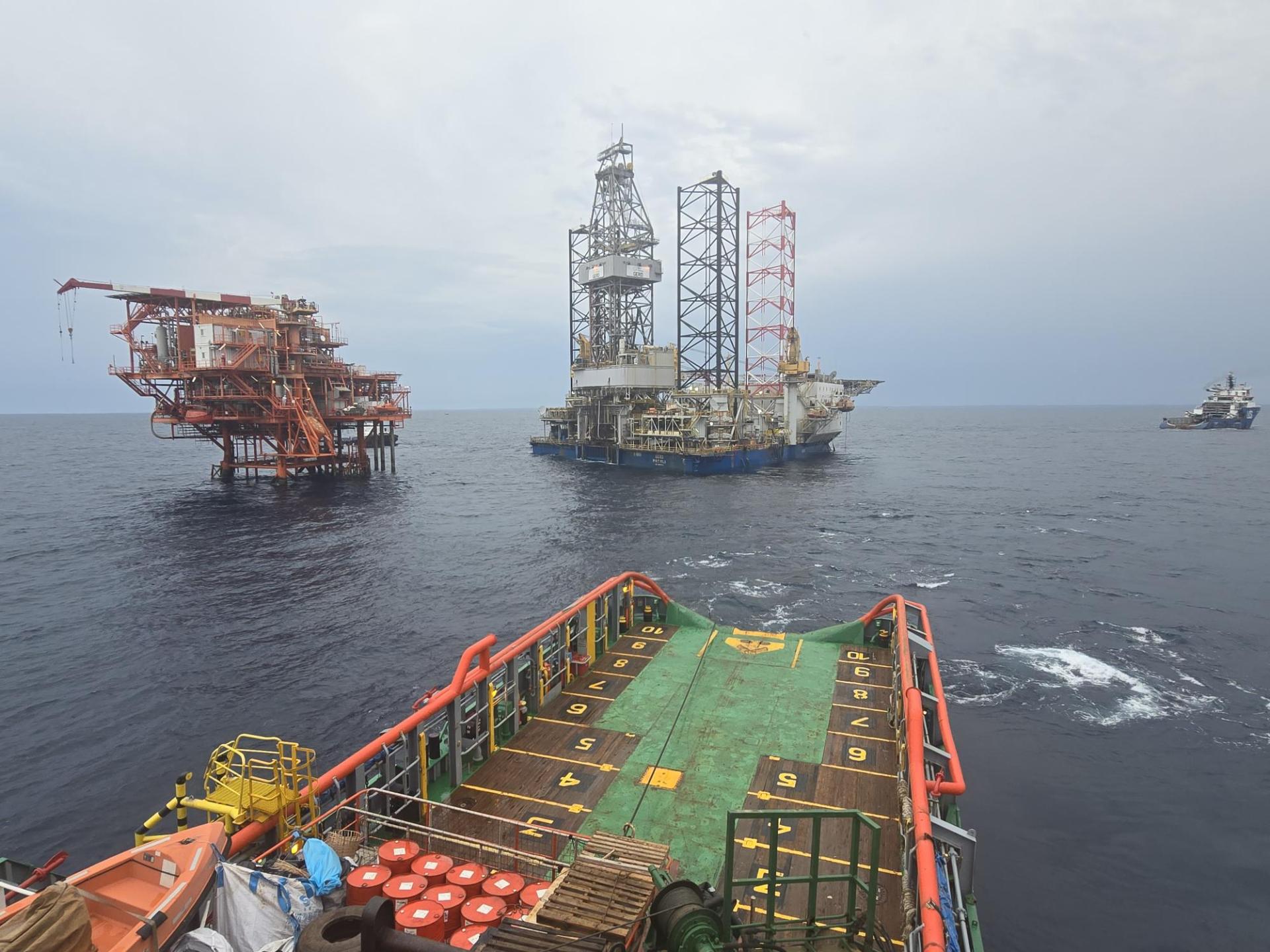
Nikolay Vasilev: From February 19 to 26, 2026, we were involved in the relocation and towing of a jack-up from Benin to Côte d’Ivoire, off the coast of Abidjan. The transit covered 506 nautical miles, or nearly 940 kilometers. It took seven days, at an average speed of 3 knots, followed by an additional three days to complete the jack-up’s final positioning near the Foxtrot platform. Before the towing operation began, another BOURBON vessel, the MPSV Bourbon Evolution 802, had carried out seabed clearance work to prepare the positioning area.
Which vessels were involved in the towing operation?
NV: Two vessels were primarily involved during the transit. The GH Atlantis was the main towing vessel, while the Bourbon Liberty 216, on which I was sailing, provided assistance on the starboard side of the jack-up. Our role was to help maintain control of the jack-up throughout the transit and adjust our position and actions according to the conditions encountered. On this type of operation, coordination between the vessels is essential.
What are the main challenges involved in a towing operation of this kind?
NV: The absolute priority is the safety and stability of the jack-up throughout the transit. We constantly monitor the sea conditions, the convoy’s speed, the towing tension and the jack-up’s movements. The speed is adjusted according to the conditions and the instructions of the Rig Move Master. During this operation, we travelled at an average speed of 3 knots, reaching a maximum of 4.5 knots. You also need to anticipate how the situation may evolve. Towing is not simply about pulling a vessel: you constantly have to assess what is happening and adapt the crew’s actions accordingly.
Did approaching the Foxtrot platform make the operation more complex?
NV: Yes. As we approached the platform, the conditions became more challenging due to strong currents in the area. The final positioning therefore required three towing vessels: the GH Atlantis providing the main pulling force, the Bourbon Liberty 216 positioned aft on the starboard side, and the VB Baobab on the port side. Depending on the situation and their respective bollard pull capabilities, the Bourbon Liberty 216 and the VB Baobab had to switch positions several times to maintain optimal control of the jack-up.
The objective was to position the jack-up just two meters from the platform. How do you prepare for such a precise maneuver?
NV: Everything starts with preparation. Before the operation, the Bourbon Liberty 216 was inspected by the Rig Move Master and the Marine Warranty Surveyor. We prepared the towing equipment and checked all critical equipment, including the shark jaws and towing pins.
Every piece of equipment must be fully operational, and every crew member must know exactly what their role is. In this type of operation, there is no room for improvisation. Coordination is also essential. The Rig Move Master and the Offshore Installation Manager initially coordinate the operation from the jack-up. During the towing phase, operational control is then transferred to the lead towing vessel, the GH Atlantis.
What exactly was your role as a Senior Captain?
NV: My role was to bring my experience to the Master and the crew, particularly during the most critical phases of the operation. There were 14 crew members on board the Bourbon Liberty 216, including bridge officers and deck teams specifically trained and prepared for this type of operation.
My role is also about sharing my experience, anticipating potential situations and supporting the Master and crew in their decision-making.
What skills are essential to work in this profession?
NV: Experience is obviously essential, but it is not enough. You need to be rigorous, able to quickly assess a situation and remain calm when conditions become challenging. Communication is also fundamental. During an operation like this, several vessels are working simultaneously around the jack-up. Each team needs to know its role and understand what the others are doing. Coordination and trust between the crews are therefore essential.
What is the most demanding part of this type of mission?
NV: The final positioning is certainly one of the most demanding phases. When the jack-up has to be positioned just two meters from a platform, maximum concentration is required. The currents, the movements of the jack-up and the actions of the different towing vessels all have to be continuously taken into account. You need to be able to adjust the maneuver in real time while maintaining an overall view of the situation. This is precisely when collective experience makes the difference. Good preparation allows you to anticipate, but you also need to be able to adapt to the reality of the operation.
What are your key takeaways from this operation?
NV: The operation was completed as planned, and we received very positive feedback from the client’s Rig Move Master and OIM. For me, it perfectly illustrates what makes the role of a Master in offshore towing so rewarding: preparing, anticipating, coordinating and making decisions, while always keeping safety as the top priority.
It also highlights the importance of having equipment maintained to the highest standards and being able to rely on experienced crews. In critical operations, it is the combination of preparation, technical expertise and teamwork that makes success possible.

